How Location Changes Your Dating Life More Than You Think
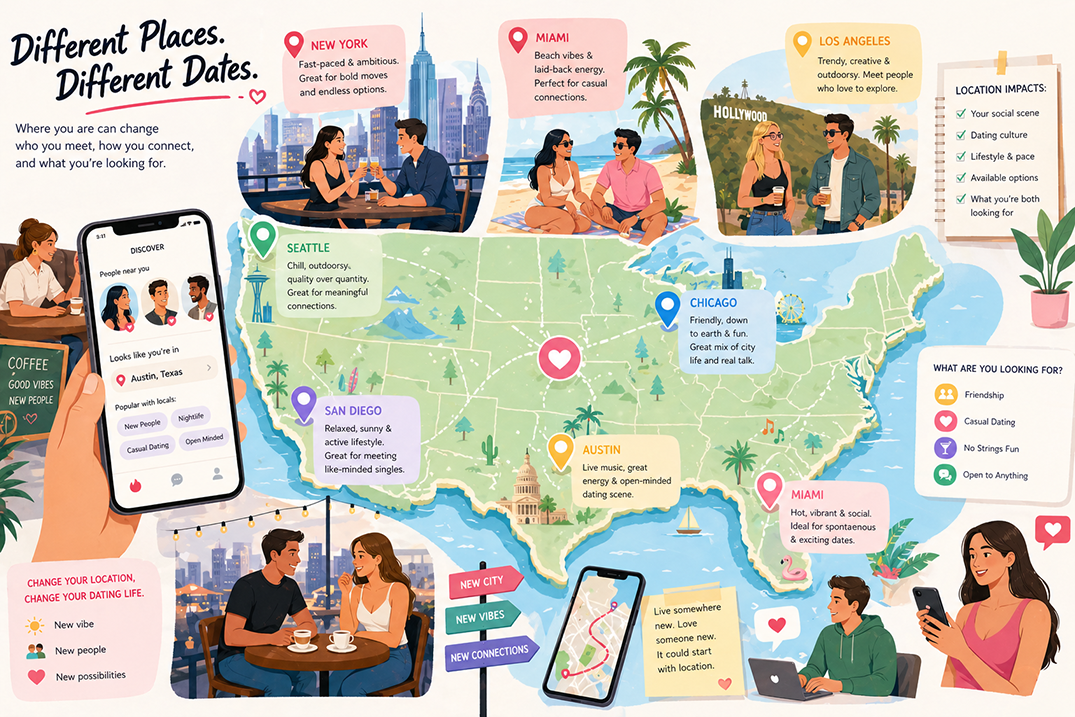
Why Where You Live Shapes Who You Meet
People love to talk about dating like it all comes down to confidence, chemistry, or saying the right thing at the right time. And sure, those things matter. But one of the biggest factors in your dating life is something most people barely think about: Location.
Not just your city, but the pace of it. The kind of people it attracts. The way people spend their time there. The social habits, the nightlife, the culture, the energy. All of it quietly shapes how people flirt, how they date, what they expect, and what they’re actually open to.
That’s why two people with the same personality can have completely different dating experiences just because they live in different places.
You can be charming, attractive, and socially confident—but if you’re in the wrong environment, dating can still feel frustrating. On the other hand, the right city can make everything feel easier. Better conversations. Better chemistry. Better timing. More opportunities.
That’s also why so many people end up thinking they’re “bad at dating” when the real issue is that they’re trying to connect in a place that doesn’t match what they actually want.
If you’ve ever felt like dating got easier the moment you changed cities, changed neighborhoods, or even changed your routine, you’ve already seen this in action.
And if you’re trying to improve your options, the smartest place to start is understanding how location changes the entire game—and how to use that to your advantage when you meet local singles.
Big Cities Create More Opportunity—But Less Patience
Dating in a major city is a completely different experience than dating in a smaller town, and the difference usually shows up fast.
In bigger cities, you have volume. More people, more events, more nightlife, more options, more constant movement. On paper, that sounds ideal—and in a lot of ways, it is. You’re more likely to meet someone attractive, interesting, and available in a large city than in a place where everybody already knows each other.
That’s the upside.
The downside is that abundance changes behavior.
When people feel like they have endless options, they move differently. They’re quicker to lose interest, slower to commit, and more likely to treat dating like something they can endlessly optimize. That doesn’t mean people in cities don’t want real connection. It just means they tend to be more selective, more distracted, and less patient.
You’ll usually notice this in the early stages. Conversations move fast. Interest is immediate—or gone. People are more likely to meet quickly, but they’re also less likely to entertain something that feels slow, confusing, or overly complicated.
That’s why city dating often rewards confidence and momentum more than perfection.
If you’re in a larger metro area, it helps to browse local singles by location instead of wasting time trying to force chemistry in the wrong circles.
Smaller Towns Have Less Variety—But More Familiarity
Smaller cities and suburban areas work differently.
There are fewer people, fewer new faces, and less constant movement. That can make dating feel slower, but it also changes the emotional tone of it.
People tend to be less rushed. More familiar. Less transactional. There’s often less of the “always looking for the next option” mindset that shows up in bigger cities. That can make dating feel more grounded—but it can also make it feel repetitive.
The biggest challenge in smaller areas usually isn’t meeting people. It’s meeting the right people.
The pool is smaller, social circles overlap more, and the same patterns tend to repeat. You see the same people on the same apps, in the same bars, at the same spots. That can make dating feel limited fast.
This is where location strategy matters even more.
Sometimes the fix isn’t changing who you’re talking to. It’s changing where you’re looking. A different city nearby, a different crowd, a different type of person, or simply widening your reach enough to find singles ready to meet tonight outside your usual routine.
Neighborhoods Matter More Than People Realize
A lot of people think in terms of city, but neighborhood matters just as much—sometimes more.
Two people can live in the same city and have completely different dating lives based on what part of it they spend time in.
One neighborhood is young, social, and full of nightlife. Another is quieter, more settled, more relationship-oriented. One attracts ambitious professionals. Another attracts creatives. Another is built around convenience and routine.
That changes who you meet and how they move.
Even the same person can feel more attractive in the right environment. More social. More relaxed. More likely to connect.
This is why “dating in New York” is too broad to mean much on its own. Dating in the West Village feels different than dating in Midtown. Dating in Brooklyn feels different than dating on the Upper East Side.
The same is true almost everywhere.
If your dating life feels stale, it’s worth asking whether the issue is really your approach—or just the environments you keep repeating.
Sometimes the easiest way to improve your dating life is to stop relying on the same routines and browse members in your area with a little more intention.
Different Cities Reward Different Dating Styles
This is where most people get it wrong.
They assume the same approach works everywhere.
It doesn’t.
The energy that works in Miami won’t always work in Chicago. The pace that works in Los Angeles won’t always land in Boston. What feels confident in one city can feel too much—or not enough—in another.
Some places reward directness. Some reward subtlety. Some reward spontaneity. Some reward consistency.
That doesn’t mean you need to become someone else. It just means the way you date should make sense for where you are.
In faster cities, hesitation usually hurts you. In slower ones, forcing momentum too quickly can backfire.
In nightlife-heavy places, chemistry tends to build faster. In quieter areas, trust usually matters more upfront.
People respond differently depending on what they’re used to. The more you understand the local dating rhythm, the easier it gets to move naturally in it.
That’s why learning how to connect with local singles in a way that fits the environment matters more than memorizing generic dating advice.
Lifestyle Compatibility Starts With Geography
A lot of attraction gets blamed on “chemistry” when it’s really just lifestyle compatibility.
And lifestyle is heavily shaped by geography.
Where people live affects how they spend their time, how often they go out, how social they are, how spontaneous they can be, and what kind of dating rhythm actually fits into their life.
Someone in a walkable city with bars, restaurants, and nightlife everywhere will date differently than someone who drives thirty minutes for everything. Someone near the beach will date differently than someone whose social life revolves around work and winter.
That doesn’t just affect logistics. It affects behavior.
It changes how quickly people meet, how often they see each other, what dating looks like on a random Tuesday, and how naturally things progress.
A lot of “bad chemistry” is really just two people living in completely different rhythms.
That’s why it helps to find local matches now in places where your lifestyle actually lines up with the kind of connection you want.
Why Some Cities Make Casual Dating Easier
Some places naturally make casual dating easier.
Usually it comes down to three things:
- social density -
- nightlife -
- low-friction logistics -
Cities where people go out often, stay out late, and meet new people constantly tend to create faster chemistry and lower-pressure dating.
That’s why casual dating tends to thrive in places with stronger nightlife, tourism, walkability, and a culture that encourages spontaneity.
In those places, it’s easier to flirt, easier to meet, and easier to keep things light.
If that’s what you’re looking for, it helps to go where the energy already supports it and browse Florida singles or browse California singles where casual dating tends to move more naturally.
Why Some Places Naturally Lean More Serious
The opposite is true too.
Some locations naturally create slower, more relationship-oriented dating.
Less nightlife. Less social turnover. Smaller circles. More routine. Less distraction.
In those places, dating tends to move slower—but often with more intention.
That doesn’t make it better or worse. Just different.
The key is knowing what kind of environment you’re in and adjusting your expectations accordingly.
Trying to force casual dating in a place where people date more seriously usually creates friction. Trying to force heavy commitment in a place built around spontaneity does the same thing.
The better move is understanding the environment and learning how to work with it instead of against it.
That’s also why it helps to browse Texas singles or browse New York singles depending on the kind of pace and dating style you’re actually looking for.
The Smartest Dating Move Is Often a Geographic One
A lot of people spend too much time trying to fix themselves when the easier fix is changing the environment.
Sometimes the problem isn’t your confidence. It isn’t your profile. It isn’t your texting.
Sometimes you’re just fishing in the wrong pond.
The right city, neighborhood, or social environment can change your dating life faster than any advice ever will.
It can change who you meet, how often attraction happens, how easy dating feels, and how naturally things move.
That’s why one of the smartest things you can do is stop thinking about dating as just chemistry—and start thinking about it as geography too.
Because location doesn’t just affect who you meet.
It affects everything that happens after.